
Logo Printing Methods for Custom Bags: Screen Printing, DTF, Digital Printing, Sublimation & Embroidery
By Bincai Import and Export Team | Updated: November 18, 2026
Choosing the right logo decoration method is an important part of developing custom promotional bags, tote bags, drawstring bags, pencil cases and pouches. The best option depends on the artwork, fabric composition, surface finish, stretch, logo size and placement, order quantity and the appearance the buyer wants.
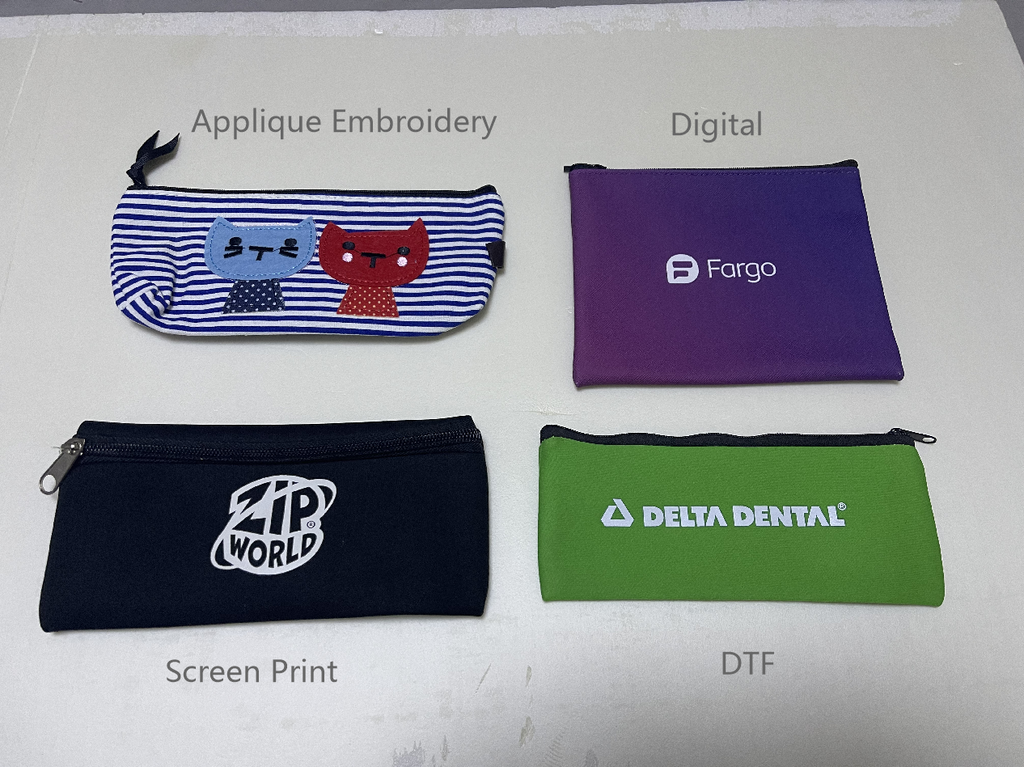
Quick answer: For a simple one-colour logo, screen printing is often the first method to consider. For multi-colour or gradient artwork, DTF heat transfer may be suitable if the transfer material matches the fabric. For clearly separated colour areas, sublimation can be considered when the fabric is compatible, especially polyester-based light-coloured material. Direct digital printing may suit detailed designs or printed fabric panels. Embroidery is an option when the buyer wants a raised stitched logo. These are starting points: the final method should be chosen with the buyer and checked on an actual material sample.
Bincai has 15 years of experience in custom bag sourcing and production coordination. This guide explains how we assess decoration options, what affects cost and lead time, and what information buyers should provide before requesting a quotation.
📑 In this guide
Quick Guide: Which Logo Method Should You Discuss First?
| Your artwork or project requirement | Method to discuss first | What must be checked |
|---|---|---|
| One-colour logo or lettering, especially when a Pantone colour reference is important | Screen printing | Number of screens, print area, fabric surface and ink suitability |
| Multi-colour or gradient artwork that needs a detailed transfer image | DTF heat transfer | Fabric stretch, transfer-film type, heat tolerance and adhesion |
| Clearly separated colour areas on a suitable polyester-based fabric | Sublimation printing | Fibre content, base fabric colour, print area and heat tolerance |
| Detailed printed graphics or a design across a fabric panel | Digital printing | The exact printing technology, fabric preparation and whether printing is done before sewing |
| A raised, stitched logo with a textured appearance | Embroidery | Stitch count, logo area, fabric stability, machine and backing |
This table is a starting point, not an automatic rule. Buyers can specify their preferred process. If the buyer is unsure, Bincai can review the artwork and material and explain the practical options before sampling.
1. Screen Printing for Custom Bags
Screen printing transfers ink through a prepared screen onto the bag material. For many custom bag projects, it is a practical option for simple, solid-colour logos, lettering and clear graphic shapes.
When to consider screen printing
- The logo uses one solid colour or a limited number of spot colours.
- The buyer wants a specific colour reference, such as a Pantone colour.
- The artwork has clear shapes and does not rely on photographic gradients.
- The fabric has a suitable printing surface and the order quantity supports the screen preparation.
What affects screen printing setup?
The number of screens and the print area are determined by the actual logo artwork, colour separation and placement. A one-colour logo may require a different setup from a multi-colour design. The print area also depends on the size and position of the logo on the bag.
When colour consistency is important, buyers can provide a Pantone reference. Pantone explains the role of spot colours in communicating brand colours; however, the final appearance on a particular fabric should still be checked with a physical print sample. See Pantone’s explanation of colour spaces and spot colours.
Points to check
Ink selection and curing must suit the fabric and its finish. Flexible or stretch fabrics may need a suitable ink system and process to reduce the risk of cracking. Ask for a print sample on the actual bag material rather than relying on a sample printed on a different fabric.
2. DTF Heat Transfer for Custom Bags
DTF means Direct-to-Film. The design is digitally printed onto a special transfer film and then applied to the product using heat and pressure. DTF is one type of heat-transfer process; it should not be used as a blanket name for every transfer method.
When to consider DTF heat transfer
- The logo contains multiple colours, gradients or relatively detailed artwork.
- The buyer wants a transfer-style printed logo rather than a screen-printed ink surface.
- The fabric and surface can accept the required heat, pressure and transfer adhesive.
- The transfer can be placed on a suitable flat area of the bag or on a fabric panel before assembly.
Match the transfer to the fabric stretch
DTF transfer materials can have different stretch characteristics. As a practical starting point, a lower-stretch transfer option can be considered for non-stretch fabrics, while a higher-stretch option should be considered for elastic or stretch fabrics. The correct choice depends on the actual fabric, transfer material and degree of stretch. Bincai recommends confirming the combination with a sample before bulk production.
Points to check
The transfer layer may feel different from the original fabric. Heat-sensitive materials, coated surfaces, satin-like finishes and textured fabrics need particular attention. Check the transfer after application and cooling, then carry out any agreed flexing, rubbing or laundering checks relevant to the product’s intended use. Do not assume that a DTF transfer suitable for one fabric will perform identically on another.
Reference setup fee: Bincai’s current reference DTF setup/plate fee is USD 30 for single-colour artwork and USD 45 for full-colour artwork. The applicable charge should be reconfirmed against the logo size, artwork and transfer-film requirements before an order is placed.
For technical background on DTF transfer film, see DuPont’s Artistri DTF transfer-film product information. The film manufacturer’s specifications are not a guarantee for every fabric; the actual material combination still needs testing.
3. Sublimation Printing for Custom Bags
Dye-sublimation printing uses a printed transfer design and heat to transfer dye into compatible synthetic fibres. It is commonly considered for polyester-based fabrics and can reproduce detailed, multi-colour artwork. White or light-coloured polyester fabrics are often the most suitable starting point because sublimation does not apply an opaque white ink layer.
When to consider sublimation
- The bag fabric is confirmed as suitable for sublimation, usually a compatible polyester-based material.
- The design contains colour areas, graphics or patterns that can be transferred onto the selected fabric.
- The base fabric colour supports the intended logo colours.
- The bag panel can be printed with the required process before sewing, if that is the most suitable production route.
Points to check
Sublimation is not suitable for every fabric. Fibre content, fabric coating, base colour and heat resistance affect the result. It generally works best on white or light-coloured polyester-based materials; it is not a universal option for cotton, dark fabrics, PU or every type of Oxford fabric. Ask the supplier to confirm the exact fabric and provide a sample before approving production.
For a basic explanation of the process and fabric considerations, see Epson’s guide to dye-sublimation printing.
4. Digital Printing for Custom Bags
“Digital printing” can refer to more than one production technology. It may mean printing directly onto fabric, printing onto transfer paper for a later transfer process, or another digital workflow. For this reason, buyers should ask the supplier to identify the exact process rather than relying on the general term alone.
When to consider digital printing
- The artwork contains detailed illustrations, multiple colours or gradients.
- A larger section of fabric needs a printed design.
- The selected fabric is compatible with the printer, ink system and any required pre-treatment.
- The design may be more efficiently printed on a flat fabric panel before the bag is sewn.
Points to check
Fabric composition, surface treatment, colour, ink system and finishing all affect the result. Before confirming a quotation, ask which digital process will be used, whether the fabric needs pre-treatment, and whether printing will take place before or after bag assembly.
Bincai coordinates digital printing through a specialist production supplier. The exact printing route and material compatibility are confirmed for each project; digital printing should not be described as an in-house process at Bincai.
5. Embroidery for Custom Bags
Embroidery creates a logo by stitching thread into a suitable bag material. It gives the design a raised, tactile appearance and can work well for brand marks, lettering and bold shapes.
When to consider embroidery
- The buyer wants a raised, stitched logo rather than a printed surface.
- The artwork remains clear when converted into stitches.
- The fabric and bag construction can support stitching without unacceptable distortion.
- The logo area is accessible to the embroidery equipment.
What affects embroidery cost and quality?
The embroidery area and stitch count are important factors. A larger or more detailed logo usually requires more stitches and production time. Digitizing, thread colours, backing and fabric stability should also be considered. Very small text, fine lines and photographic gradients may not translate well into embroidery.
Bincai arranges embroidery through a specialist embroidery workshop. Depending on the design and quality requirements, a domestic-machine or imported-machine option may be discussed. For a project with higher detail requirements, an imported-machine route may be considered, but the actual result should be judged from the sew-out or sample rather than machine origin alone.
6. Logo Decoration Methods Compared
Use this table to shortlist options. The final recommendation depends on the confirmed fabric, logo artwork, order details and sample result.
| Method | Common starting point | Main cost factors | Production arrangement at Bincai | Reference decoration processing time |
|---|---|---|---|---|
| Screen printing | Often considered for one-colour or limited spot-colour logos; Pantone references can be provided | Artwork, number of screens, colours and print area | Handled by Bincai’s own team | About 3–7 working days |
| DTF heat transfer | Often considered for multi-colour or gradient logos on compatible fabrics | Artwork size, transfer type, film/material and application requirements | Arranged with workers at the Yiwu workshop | About 3–5 working days |
| Sublimation printing | Can be considered for compatible polyester-based fabric and suitable base colours | Fabric, printed area, artwork and transfer requirements | Confirmed according to the project and production supplier | Confirmed per project |
| Digital printing | Detailed graphics or printed fabric panels, depending on the process | Printing technology, ink system, fabric preparation and print coverage | Coordinated through a specialist supplier | Confirmed per project |
| Embroidery | Raised logos and lettering on suitable bag materials | Embroidery area, stitch count, detail, thread and machine option | Arranged through a specialist embroidery workshop | About 7–12 working days |
Timing note: These are reference processing times for the decoration step, not a guaranteed total lead time for bag development, sewing, packing or international shipping. Actual timing depends on artwork, material, quantity, workshop schedule and sample approval. The schedule for each order must be confirmed in the quotation.
7. Artwork, Logo Placement and Sample Checks
What artwork should you send?
- Logo file: An editable vector file such as AI, EPS or vector PDF is usually helpful for logos and lettering.
- Image artwork: For raster artwork, provide a high-resolution file at the intended print size. Confirm the accepted file format for the selected process.
- Colour reference: Provide Pantone references when brand-colour matching is important, especially for screen printing.
- Logo size: State the intended width and height, not just “small” or “large”.
- Placement: Mark the panel, side and distance from seams, zippers, handles or edges.
- Fabric details: Provide the material composition, colour, coating or surface finish, and whether the fabric stretches.
What should the sample confirm?
- The sample uses the intended material, fabric colour and surface finish.
- The logo size, colour, position and orientation match the approved artwork.
- The selected process gives the expected appearance and handfeel.
- For DTF, the transfer is matched to the fabric stretch and checked for edge lifting or cracking.
- For sublimation, the base fabric and colour give an acceptable result.
- For embroidery, the stitch detail is legible and the fabric does not pucker unacceptably.
- Any required rubbing, flexing or laundering test is agreed in advance, including the test method and pass criteria.
There is no universal minimum line width, bleed or file setting that applies to every machine and material. Ask for a process-specific artwork template before preparing final production files. The approved physical sample or signed-off specification should be retained as the reference for bulk production.
8. What Affects Cost, MOQ and Processing Time?
Decoration cost should be quoted against the actual artwork and product specification. A price comparison is only meaningful when the bag, logo size, print area, quantity and packaging requirements are the same.
- Screen printing: The number of colours and screens, logo placement and print area affect setup and production cost. Screen preparation is determined by the artwork.
- DTF heat transfer: The transfer type, film/material, logo size, fabric stretch and application requirements affect the quotation. A low-stretch or high-stretch transfer option should be selected according to the fabric.
- Sublimation and digital printing: The fabric, base colour, printing technology, pre-treatment, printed area and finishing affect the cost.
- Embroidery: The embroidered area, stitch count, design detail, thread colours, digitizing and machine option affect the quotation.
For DTF heat transfer, the current reference setup/plate fee is USD 30 for single-colour artwork and USD 45 for full-colour artwork, subject to confirmation against the logo size and transfer-film requirements. For screen printing, the number of screens and any related setup charges depend on the artwork, colour separation and print area. Other preparation charges, where applicable, are confirmed before the order is placed.
For made-to-order bags and pouches, Bincai’s general reference MOQ is around 1,000 pieces per style. The actual MOQ depends on the bag design, material, construction, decoration and supplier requirements, so it must be confirmed for each project. A ready-stock product’s order policy should not be assumed to apply to custom-made bags.
The basic sample fee for a standard custom bag style is USD 50 per design. This reference fee applies to ordinary custom bag styles. Special or more complicated structures may require a separate sample quotation after the design and construction are reviewed. The applicable sample fee will be confirmed before sampling begins.
Decoration processing times are shown in the comparison table above. They are not the same as the full custom bag production lead time or shipping transit time. The complete schedule should be confirmed after the product specification, material, artwork, sample requirements and quantity are reviewed.
For more information, read our guides to custom bag MOQ and order quantities and the factors that affect custom bag pricing.
9. How Bincai Coordinates Custom Bag Decoration
Bincai International has 15 years of experience in custom bag sourcing and production coordination. Our office is in Zhengzhou, and we have a workshop in Yiwu. Our team visits Yiwu to coordinate production and follow up on orders.
Different decoration processes are arranged through the production route that best suits the order:
- Screen printing: Handled by Bincai’s own team.
- DTF heat transfer: Carried out by workers arranged at the Yiwu workshop. The transfer option is selected according to the fabric and its stretch.
- Digital printing: Coordinated through a specialist external printing supplier.
- Embroidery: Arranged through a specialist embroidery workshop. Domestic or imported machine options can be discussed according to the artwork and quality requirements.
Bincai can arrange basic quality checks based on the agreed order requirements. These may include visual appearance, logo position, workmanship, quantity and packaging checks. This is basic production follow-up and QC support; it should not be confused with accredited laboratory testing or an independent third-party inspection report.
Our recommendation is based on the buyer’s artwork, material, intended use and preferred appearance. If the buyer already has a preferred process, we can review whether it is practical for the selected bag. If the buyer is unsure, we can explain the options and arrange a sample for confirmation.
You can browse our custom pencil bags, drawstring bags and bags and totes for product references.
Information to include in a quotation request
- A product photo, drawing or reference link.
- Material composition, fabric colour and any coating or surface finish, if known.
- Approximate bag dimensions and construction details.
- Logo artwork, colour reference, size and preferred placement.
- Estimated quantity per style.
- Packaging requirements, destination market and target timeline.
- Your preferred decoration method, if you have one.
Discuss your custom bag project with Bincai.
Send us your bag reference, logo artwork and estimated quantity. We can review the material and decoration options and confirm the applicable sample fee, MOQ, setup charges and production schedule.
📱 WhatsApp: +86 15857935670
📧 Email: info@bincai-intl.com
Frequently Asked Questions
Which logo method is best for custom bags?
It depends on the artwork and material. Screen printing is often considered for simple one-colour logos. DTF can suit multi-colour or gradient artwork on compatible fabrics. Sublimation can be considered for suitable polyester-based materials. Digital printing may suit detailed fabric graphics, while embroidery creates a raised stitched effect. A sample should confirm the final choice.
Can screen printing use a Pantone colour?
Yes, a Pantone reference can be provided for screen-printing colour communication. The number of screens and print area depend on the actual logo artwork and placement. The final appearance should be checked on the selected bag material.
What is the difference between DTF and sublimation?
DTF prints the design onto a film and transfers that printed layer to the product using heat and pressure. Sublimation uses heat to transfer dye into compatible synthetic fibres, most commonly polyester-based fabric. The two processes have different material requirements and final appearances.
How do you choose DTF transfer for stretch and non-stretch fabrics?
As a starting point, a lower-stretch transfer option is considered for non-stretch fabric, while a higher-stretch option is considered for elastic fabric. The exact choice depends on the fabric and transfer material, so a sample test is recommended.
Is sublimation suitable for every bag material?
No. Sublimation is generally considered for compatible polyester-based fabrics and usually works best on white or light-coloured materials. It is not a universal option for cotton, dark fabrics, PU or every type of Oxford fabric. Confirm the actual composition and test a sample.
Does embroidery cost depend on the number of stitches?
Stitch count is an important cost factor, along with the logo area, design complexity, thread colours, digitizing and machine requirements. A quotation should be based on the actual logo size and embroidery file.
What are the decoration processing times?
As a reference, screen printing usually takes about 3–7 working days, DTF heat transfer about 3–5 working days, and embroidery about 7–12 working days. Digital printing and sublimation timing is confirmed by project. These are decoration-stage references, not a guarantee for the complete bag production or international delivery schedule.
What is the MOQ for custom bags?
Bincai’s general reference MOQ for many made-to-order bag projects is around 1,000 pieces per style. The final MOQ depends on the bag design, material, structure, decoration and supplier requirements. It is confirmed separately for each project.
How much is a basic custom bag sample?
The basic sample fee for a standard custom bag style is USD 50 per design. Special or more complicated structures may require a separate quotation. The applicable fee is confirmed before sampling begins.