
Why Does This Bag Cost So Much? A Transparent Breakdown of Custom Bag Pricing
By Bincai Import and Export Team | Updated: October 14, 2026
About the authors: Our in-house production and sourcing team has over 15 years of hands-on experience manufacturing custom bags and promotional accessories, serving brand buyers across 50+ countries for custom bag OEM & ODM projects. We build this guide using real production floor costing data.
“Why does this bag cost so much?” It’s the most common—and fair—question in custom manufacturing. Unlike retail, a factory quote isn’t arbitrary. It’s the sum of tangible, line-item costs. Transparency here builds the foundation for trust. This guide dissects the real cost of producing a custom bag, using real numbers from our production floor.
Table of Contents
- The Building Blocks: A Real Cost Breakdown
- The Volume Leverage: Why 10,000 pcs Costs Less Than 1,000 pcs
- The Hidden Cost Multipliers: “Small Requests” That Add Up
- Beyond the Numbers: What Are You Really Paying For?
- Common Custom Bag Pricing Pitfalls for Buyers
- Real-World Pricing Case Study
- Landed Cost: Don’t Forget Shipping, Duties & Import Fees
- Frequently Asked Questions
- Request a Transparent Line-Item Quote
The Building Blocks: A Real Cost Breakdown
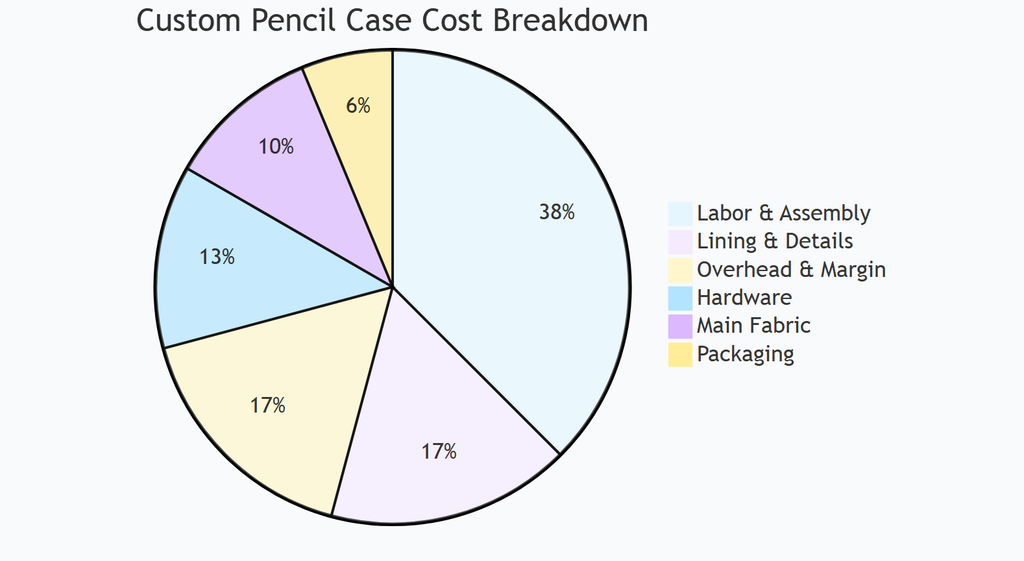
Let’s analyze a standard custom pencil case (20x10cm) as a reference. The percentages below are estimates based on typical promotional orders. Note: this cost structure applies to small promotional pencil cases; larger tote bags, backpacks, or heavy-duty bags will show different cost proportions.
| Cost Component | Details & Calculation | Cost Range (Per Piece) | % of Total Cost* |
|---|---|---|---|
| 1. Main Fabric | 600D Oxford (RMB 3.5–4.2/m). A 22x22cm piece requires approximately 0.037m with cutting efficiency factored in. | RMB 0.13–0.16 (USD 0.02–0.024) | ~10–15% |
| 2. Hardware | Nylon zipper tape (RMB 0.35–0.5/m), 0.25m used, plus No.5 nylon slider. | RMB 0.13–0.21 (USD 0.02–0.031) | ~10–20% |
| 3. Labor & Assembly | Cutting, sewing, and assembly. The most variable cost, rising yearly with skill demand. | RMB 0.7–1.2 (USD 0.10–0.18) | ~40–50% |
| 4. Lining & Extra Details | Lining fabric and additional labor for an inner pocket. | RMB 0.3–0.8 (USD 0.045–0.12) | ~15–25% |
| 5. Packaging | OPP bag (25x13cm) and 5-ply export carton cost allocation. | RMB 0.11–0.25 (USD 0.016–0.037) | ~5–10% |
| 6. Overhead, Tax & Margin | Management, operations, 13% VAT, and a sustainable factory margin for service and warranty. | RMB 0.3–0.8 (USD 0.045–0.12) | ~15–25% |
*Percentages are illustrative and shift significantly with order size, complexity, and material choices. All figures reflect 2026 China factory cost levels for promotional custom pencil cases, for reference only. Final pricing varies by specs, order quantity, and material grade. Exchange rate reference: 1 USD ≈ 6.69 RMB (October 2026). All costs listed are factory-level costing and exclude shipping, duties, and third-party inspection fees.
If you want to understand how material choice affects total cost, see our custom bag materials guide. For hardware cost drivers, see our hardware sourcing guide.
The Volume Leverage: Why 10,000 pcs Costs Less Than 1,000 pcs
Price isn’t just about adding up parts. Efficiency and scale drive down the cost per unit in non-linear ways:
- Material procurement: Buying 1 roll vs. 10 rolls of fabric. Suppliers offer tiered pricing (e.g., RMB 10/m for 1–50 rolls, RMB 9.8/m for 50–300 rolls). Purchasing less than a full roll can inflate costs by 30–50%.
- Fixed cost amortization: A RMB 300 shipping fee for raw materials spread across 1,000 units adds RMB 0.3 each. Across 10,000 units, it’s just RMB 0.03.
- Production efficiency: Workers and machines gain speed and reduce waste with large, repetitive runs.
| Cost Factor | 1,000 pcs | 10,000 pcs | Why It Drops |
|---|---|---|---|
| Fabric sourcing | Partial roll surcharge | Full roll, tiered discount | Bulk purchasing power |
| Machine setup | Spread over 1,000 units | Spread over 10,000 units | Fixed cost amortization |
| Labor efficiency | Standard | Faster, less waste | Learning curve and line specialization |
| Shipping raw materials | RMB 0.30/unit | RMB 0.03/unit | Fixed freight amortization |
This is why MOQ exists and why unit prices drop with quantity. It’s the economics of scale in action. For a full guide on MOQ negotiation, see our MOQ negotiation guide.
The Hidden Cost Multipliers: “Small Requests” That Add Up
Beyond base specs, these commonly overlooked requests significantly impact the final quote:
- Fully custom components: A custom-molded zipper pull or printed OPP bag requires new tooling and has its own high MOQ.
- Special material sourcing: A unique Pantone color may require a fabric mill to run a minimum dye lot of 1,000kg, far exceeding your order needs.
- Multi-step approvals and revisions: Each additional sample round or design change after production begins incurs extra labor and delay costs.
Beyond the Numbers: What Are You Really Paying For?
A price extremely close to cost means no margin for service, quality assurance, or problem-solving. It’s a transactional, high-risk model where any issue leads to dispute or loss.
A reasonable, sustainable price includes:
- Risk mitigation: It’s your order’s insurance. It covers professional project management, proactive quality control, and the factory’s ability to handle unforeseen issues without compromising your delivery.
- Partnership value: It enables communication, transparency, and the willingness to go the extra mile to ensure your success.
In quality management, this is known as the cost of quality—prevention and appraisal costs that prevent far larger failure costs downstream.
In a market with countless suppliers, finding an honest, capable partner who won’t cut corners on your behalf is the ultimate efficiency. It leads to stable, fast, and repeatable cycles—the true driver of long-term business growth. For a practical guide on evaluating suppliers, see our factory verification checklist. If this is your first order, start with our 10-checkpoint first order guide.
Common Custom Bag Pricing Pitfalls for Buyers
Many brand owners run into unexpected budget overruns by overlooking these common traps:
- Selecting custom tooled hardware without confirming tooling fees and tool ownership.
- Negotiating only unit price while ignoring separate sampling, mold, shipping, or inspection fees.
- Switching fabric or artwork after mass production starts, triggering rework charges.
- Comparing quotes without aligning the same material grade, QC standard, and packaging requirements.
Real-World Pricing Case Study
A US DTC startup contacted us for 1,000 custom canvas tote bags. Their initial target budget was built only around fabric and sewing cost. The client planned for custom Pantone fabric dye plus custom engraved zipper pulls, which added tooling fees and minimum dye-lot surcharges.
We shared line-item costing and proposed switching to in-stock standard fabric color plus off-the-shelf hardware. The adjustment eliminated USD 420 in tooling and dye surcharges, while retaining their branding via screen printing. The project stayed on budget and passed our QC inspection with zero batch color deviation.
This example illustrates that small spec changes can have a massive impact on total landed cost before production starts.
Landed Cost: Don’t Forget Shipping, Duties & Import Fees
Many buyers compare factory FOB unit prices side-by-side but overlook landed cost, which often makes or breaks your final budget.
FOB pricing only covers manufacturing and loading the goods at the Chinese port. Full landed cost adds:
- Ocean freight or air freight
- Cargo insurance
- Destination import duties & customs clearance fees
- Local warehouse delivery in your country
Quick Incoterm Note
Buyers new to Chinese manufacturing often confuse EXW, FOB, and CIF. FOB is the most common term for custom bag orders, but always confirm the Incoterm version with your supplier, as responsibility for risk and freight changes drastically between terms.
For smaller orders, shipping and duty can represent a surprisingly large percentage of your total spend. Always ask your supplier to separate factory price and logistics estimates, so you can calculate full landed cost before approving the order.
Frequently Asked Questions
Why is labor the largest cost component in custom bag manufacturing?
Cutting, sewing, and assembly are skilled, labor-intensive processes. Unlike raw materials, labor costs rise yearly with wage inflation and skill demand, and cannot be easily automated for complex sewn products.
Why does the unit price drop so much when I increase order quantity?
Several costs are fixed regardless of order size—shipping raw materials, machine setup, and tooling amortization. When spread across more units, the per-piece cost drops significantly. Larger runs also improve production efficiency and reduce waste.
Why does a custom Pantone color cost more than a standard color?
Custom dyeing requires a fabric mill to run a minimum dye lot (often 1,000kg or more). If your order uses only a small portion of that lot, the cost per meter increases substantially. Standard stock colors avoid this premium.
What does a sustainable price actually include?
A sustainable price covers quality materials, skilled labor, strict QC, and a reasonable factory margin that supports long-term service. It also provides a buffer to handle unexpected issues without compromising quality or delivery.
How can I verify that a quote is fair and not inflated?
Ask for a line-item breakdown: fabric, hardware, labor, lining, packaging, overhead, and margin. A transparent factory will provide this without hesitation. Compare across two or three suppliers and look for consistency in the ranges, not just the total price.
What are common hidden fees in custom bag manufacturing quotes?
Common hidden charges include tooling fees, expedited shipping, third-party inspection charges, custom artwork setup, special packaging, and extra sample revisions. Always request a full line-item quote before committing.
Can I get a price breakdown before placing a sample order?
Yes. At Bincai, we provide transparent line-item cost breakdowns for your custom bag project before sampling, so you understand all cost drivers upfront.
How much should I budget for custom bag tooling fees?
Tooling fees depend on custom hardware, custom molds, or engraved zipper pulls. Standard off-the-shelf hardware requires zero tooling cost, while fully custom molded hardware typically ranges from USD 150–600 per mold, and tool ownership terms vary factory by factory.
What is the difference between FOB price and landed cost for custom bags?
FOB price covers only manufacturing cost and loading at the Chinese port. Landed cost adds ocean or air freight, insurance, import duties, customs clearance, and local delivery fees to your warehouse. Many buyers underestimate landed costs and go over budget.
Get a Transparent Quote for Your Project
We believe an informed client is our best partner. Share your specifications, and we’ll provide a detailed, line-item cost analysis—no hidden fees, just clarity.
📱 Get a Cost Breakdown on WhatsApp: +86 15857935670
📧 Email Your Specs: info@bincai-intl.com
Send us your design or even a similar product photo. We’ll show you the “why” behind the price.
Related reading: Explore our custom bag materials guide, learn about MOQ negotiation, review the full production workflow, and understand our QC process before requesting a quote. You can also browse our custom promotional bags collection for product references.