
How to Verify a Reliable Custom Bag Manufacturer in China: 5-Step Checklist
By Bincai Import and Export Team | Updated: August 18, 2026
- Step 1: Verify Factory vs. Trading Company (Manufacturer vs Trader)
- Step 2: Evaluate Their Quality Control System
- Step 3: Verify Production Capacity and Export Experience as a Reliable China Factory
- Step 4: Assess Communication and Professionalism
- Step 5: Confirm Compliance and Sustainability Practices
- Frequently Asked Questions
Finding a trustworthy manufacturing partner in China can be the most critical—and challenging—part of your sourcing journey. This 5-step checklist is designed to help you verify a reliable custom bag manufacturer in China before you commit. According to a 2023 survey by the International Trade Centre, nearly 40% of small and medium importers reported at least one serious supplier issue in the past two years. These issues ranged from inconsistent quality to late shipments or misrepresentation. For custom bags and pouches, where stitching, fabric, and logo placement directly affect your brand, the cost of choosing the wrong factory often exceeds the savings from a lower unit price.
This guide is written specifically for buyers sourcing custom sewn products—pencil cases, cosmetic bags, drawstring bags, eye masks, Christmas hats, and similar promotional items—from China.
Step 1: Verify Factory vs. Trading Company (Manufacturer vs Trader)
Start with the most fundamental check: is the supplier a real factory or a trading company? In China’s manufacturing hubs, it is common for trading companies to present themselves as factories. They may use factory photos, claim to own production lines, and even invite you to a showroom—but the actual production is outsourced. This adds cost, slows communication, and reduces control over quality.
How to verify:
- Request a real-time video tour: Ask for a live walk-through of the workshop, cutting area, sewing lines, and quality control station. A genuine factory will be transparent. Pre-recorded videos can be reused; insist on live interaction.
- Ask specific production questions: Inquire about material sourcing, cutting tolerances, stitch density, and quality inspection steps. A factory owner or manager will answer fluently. A trader will often give vague answers or need to “check with the factory.”
- Check the business license: The business scope should explicitly include “Manufacturing” or “Production.” You can verify a Chinese business license through the National Enterprise Credit Information Publicity System (NECIPS) or request a third-party verification service.
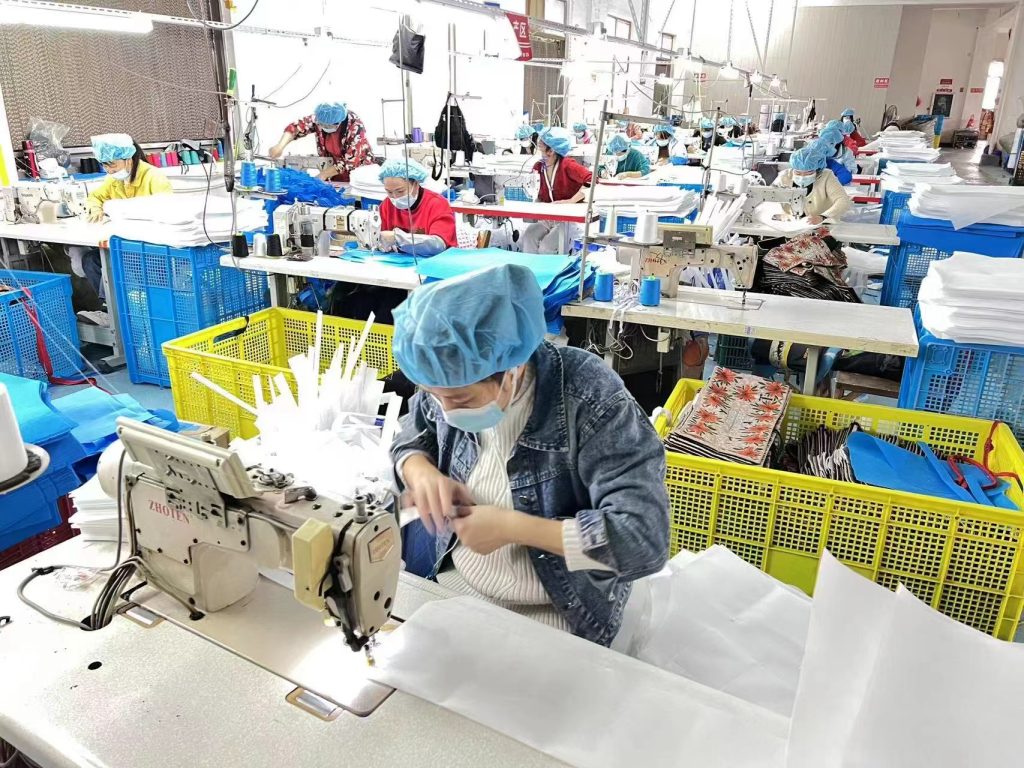
At Bincai, as an integrated factory, we openly invite clients for live video audits and detail our in-house production control from raw material to finished bags. You can see our factory environment and workflow directly here: Bincai Factory Overview Video. You can also see our custom pencil case manufacturing.
Step 2: Evaluate Their Quality Control System
Consistent quality is non-negotiable in promotional sewn products. A common complaint from importers is that pre-production samples look perfect, but bulk orders arrive with loose threads, crooked logos, or mismatched colors. This happens when there is no structured QC system between sample approval and bulk shipment.
To assess their QC system, ask the following:
- Ask about on-the-ground QC practices: In well-managed factories, each bag is individually handled during final packaging. Workers are trained to remove obvious thread defects and set aside any item with visible flaws before packing. This is not a one-off final inspection; it is built into the workflow. At Bincai, we follow this practice on every production line.
- Clarify standards upfront: For markets with strict zero-loose-thread policies, this must be formalized as a specific QC checkpoint during sampling. Routine QC covers major defects, while special requirements need specific arrangements and possibly different pricing.
- Request a sample QC report: A reputable manufacturer can show you a blank or anonymized report from a previous order. It should list checkpoints: fabric weight, color matching, stitching density, logo placement, dimensions, and packaging.
- Ask about AQL levels: Many professional buyers use Acceptable Quality Limit (AQL) standards. For sewn products, AQL 2.5 for major defects is a common benchmark. This means that in a batch of 1,000 pieces, up to 25 major defects are acceptable, depending on the sampling plan. If the factory understands AQL terminology, that is a strong positive signal.
Step 3: Verify Production Capacity and Export Experience as a Reliable China Factory
Even a factory with good samples may fail on a 10,000-piece order if their capacity is already stretched or their export experience is limited. Capacity and experience are about reliability under load.
- Discuss MOQ flexibility: Typical MOQs for custom sewn products range from 500 to 2,000 pieces depending on fabric and design. Bincai’s standard MOQ is 1,000 pieces, but we are open to discussing lower MOQs for long-term partnerships. Be cautious of suppliers that accept unrealistically low MOQs without any discussion—they may be trading companies or have unstable production capacity.
- Clarify sampling: Understand their sample process: cost, lead time, and whether the sample fee is deductible from the future order. Also ask about sample revision limits to avoid endless delays.
- Request references or case studies: Ask about experience working with international trading companies or known brands. Proven experience with export procedures—shipping documents, customs compliance, labeling—is a strong positive signal. If possible, ask for contact details of past clients and reach out directly. If they refuse, treat it as a red flag. We have a proven track record as a trusted manufacturing partner for professional sourcing groups and distributors across 50+ countries.
- Ask about export documents: Can they provide a packing list, commercial invoice, bill of lading, and certificate of origin? If they hesitate or cannot explain these documents clearly, they may lack direct export experience.
Step 4: Assess Communication and Professionalism
Smooth communication prevents countless errors in custom production. You can assess this from your earliest communications. A factory that responds slowly or vaguely during the sales stage will likely be worse during production.
- Response time and clarity: Are they prompt, clear, and proactive in addressing your questions? Do they confirm details in writing, or only verbally?
- Problem-solving approach: Do they just say “yes” to everything, or do they offer constructive suggestions from a production standpoint? For example, if your design includes a zipper that is known to break easily, a good factory will suggest an alternative before production, not after.
- Language capability: Ensure there is a dedicated contact person with sufficient English proficiency to handle technical discussions. Misunderstandings about stitch type or logo size can ruin an entire order.
- Watch for these red flags: Avoid suppliers who pressure you for immediate deposits, refuse to share business license details, avoid video calls, cannot explain production processes clearly, use a free email address for business, or ask for full payment upfront before production begins.
Step 5: Confirm Compliance and Sustainability Practices
For clients with specific requirements—such as retail chains, brands with CSR policies, or markets with strict import regulations—this step is vital.
- Ask about certifications: BSCI and Sedex are widely used social compliance audit frameworks in China’s sewn products industry. They indicate that a factory has been audited for labor conditions, working hours, and environmental practices. Note that they are audit frameworks, not certifications. Always ask to see the audit report and verify the factory name and address.
- Discuss material options: Ask if they offer or source eco-friendly materials like RPET recycled polyester, organic cotton, or water-based inks. This is increasingly important for European and North American buyers.
- Ask about product safety testing: For children’s products like pencil cases or eye masks, ask about compliance with CPSIA (US), REACH (EU), or EN71 (EU toys). A factory familiar with these requirements will save you costly testing failures later.
Your Next Move: Test This Checklist on Us
Now, we invite you to apply this checklist to Bincai Import and Export Co., Ltd. We encourage you to test this checklist on us. We welcome the verification process and will provide the requested information transparently. As a factory focused on custom bags, pouches, and promotional sewn items, we build our partnerships on transparency, quality, and reliability. Learn more about our Bincai factory quality commitment.
Ready to work with a verified manufacturer? Contact us today to request our factory profile, detailed capability presentation, or to start a conversation about your next project.
📱 Contact on WhatsApp: +86 15857935670
📧 Email: info@bincai-intl.com
Frequently Asked Questions
How do I verify a bag manufacturer is not a trading company?
Request a live video tour of the production floor, ask detailed questions about cutting and sewing processes, and check the business license for “Manufacturing” or “Production.” You can also verify the license through China’s National Enterprise Credit Information Publicity System.
What is a reasonable MOQ for custom bags?
For promotional sewn products, typical MOQs range from 500 to 2,000 pieces depending on fabric and design complexity. Some factories, including Bincai, may discuss lower MOQs for long-term partnerships.
Do you provide samples before bulk production?
Yes. A professional factory should provide pre-production samples so you can evaluate materials, stitching, and logo placement before committing to bulk. Clarify sample cost, lead time, and whether the fee is deductible from the future order.
What certifications should a reliable bag factory have?
BSCI and Sedex are common social compliance audit frameworks. For children’s products, ask about CPSIA, REACH, or EN71 compliance. Always verify that the audit report matches the factory name and address.
Pingback: MOQ in Bag Manufacturing: Negotiate with Chinese Factories - Bincai
Pingback: MOQ Bag Manufacturing: Negotiate with Chinese Factories - Bincai
Pingback: Custom Bag Materials: How to Choose the Right Fabric - Bincai
Pingback: OEM vs ODM Bag Manufacturing: How to Choose the Right Model - Bincai
Pingback: Custom Bag Manufacturing Process: Design to Delivery - Bincai
Pingback: No‑MOQ Silk Sleep Masks: Marketing Giveaways for Brands - Bincai
Pingback: Custom Event Pouches | Wedding Favors Factory - Bincai