
By Bincai Import and Export Team | Updated: November 23, 2026
Quick summary: Cosmetic bag failures cluster where quotations stay silent — lining construction, colour drift between material batches, substituted zippers, print adhesion. The seven checks below say what to ask and what evidence settles it, followed by a ten-step sample test to run before releasing a deposit.
Most cosmetic bag orders fail at the lining, the colour lab dip, or the zipper — three details that never appear on a quotation. Run these seven checks before you wire a deposit. If the supplier cannot answer checks 2, 3 and 6 with physical evidence, the price you were quoted is not the price you will pay.
This guide is written from the factory side. We sew make-up pouches, pencil cases and travel organisers for promotional distributors, beauty brands and private labels, and the same four claims come back year after year: peeling lining, colour that shifts between reorders, zip pulls that discolour within a month, prints that crack along the fold. None of them is visible in a photo of a finished bag. (If you are still verifying whether the supplier is a factory at all, start with our 5-step supplier verification checklist.)
📑 On this page
- Check 1: Have they actually sewn a pouch?
- Check 2: Is the lining specified down to the backing?
- Check 3: How do they control colour across lots?
- Check 4: What is the zipper, exactly?
- Check 5: Does the print method match the surface?
- Check 6: Will they let you test the sample like a customer?
- Check 7: What actually protects your deposit?
- Red flags that should end the conversation
- Frequently asked questions
| # | Check | Failure it prevents | Evidence to request |
|---|---|---|---|
| 1 | Real pouch experience | Lining that bunches, puckered corners | Live video of turning, lining fixing, zip-end finishing |
| 2 | Lining specified to the backing | Peeling, leaking, solvent smell | Spec: face, backing, GSM, interlining |
| 3 | Colour controlled across lots | Reorder arrives a different shade | Pantone or signed swatch plus numeric ΔE tolerance |
| 4 | Zipper defined by part | Snagging teeth, discoloured pulls | Sealed zip and pull sample with size, finish, brand |
| 5 | Print matched to surface | Cracked print, ink wiped off by cosmetics | Adhesion and rub results on your material |
| 6 | Sample tested like a customer | Faults that only appear in use | A sample you may abuse before approving |
| 7 | Deposit terms that protect you | Money gone, spec drifting, no recourse | AQL in writing, inspection right, sealed sample |
Why a Cosmetic Pouch Is Not a Small Tote Bag
A tote is judged from the outside; a pouch from the inside, twice a day, for two years. Most of what your customer notices — wipes clean, holds its shape, glides shut, no glue smell — comes down to parts a quotation compresses into one word: lining. That is why two quotes on the same artwork look unreasonable until you open both samples. The gap is lamination versus a sewn-in lining, an interlining board in the base, a 5# zip instead of a 3# coil, and whether anyone tested the print with alcohol.
Check 1: Have They Actually Sewn a Pouch?
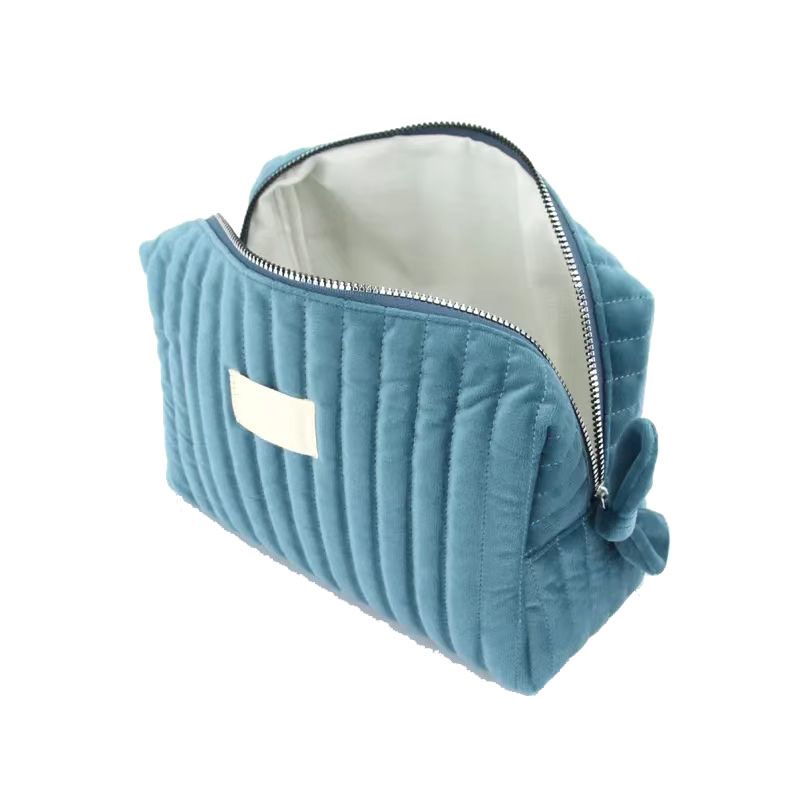
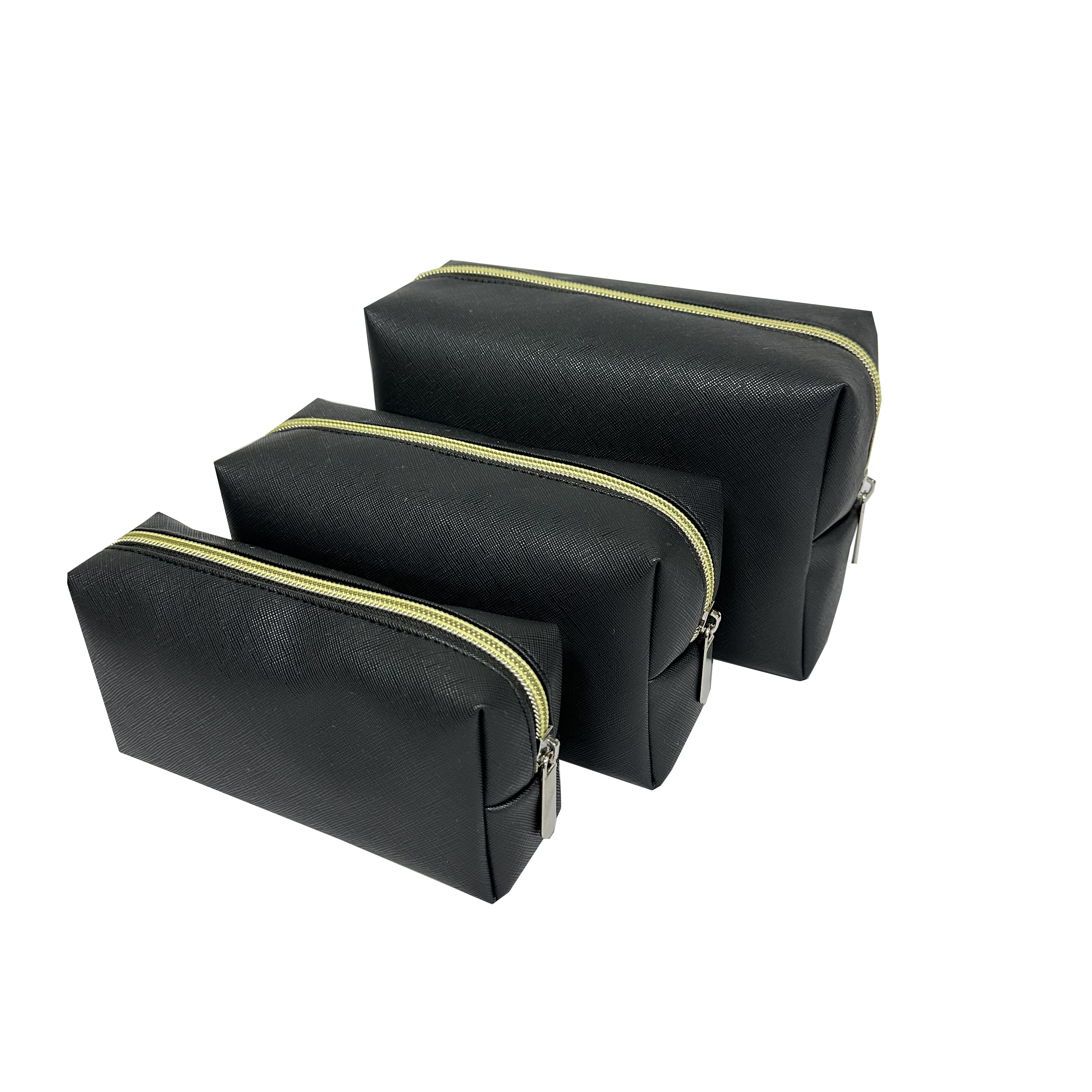
Four shapes cover most orders, and each fails somewhere else: a flat zip pouch at the corners when the lining allowance is wrong, a boxy, stand-up bag at the base seam where three panels meet, a multi-piece set where the three sizes must come from one fabric lot, and a pouch with a side handle at the handle anchors. Ask which they have run, and how long the run was.
Turning. Most pouches are sewn inside out and turned. If the inner bag is cut to the outer’s dimensions, the lining bunches at the corners and the pouch never sits flat. The allowance is usually 2–3 mm per side, adjusted for fabric and interlining. Ask what allowance they use and why: a factory answers in millimetres, a trader says “we will make it perfect”.
Lining fixing. A lining sewn only into the top seam gets pulled out of shape, and on larger travel pouches it sags into the base. Good construction adds a bar-tack at the base corners — invisible in product photos, decisive in a durability complaint.
Zip-end finishing. The zip ends are where pouches tear first: either the tape is turned into the side seam or an end tab is added. The cheap version leaves a raw tape edge that frays within months.
What to request: a live 60–90 second video of those three operations on a pouch in current production, held up to camera at the turning stage, plus photos of three pouch SKUs shipped in the last six months. Our custom makeup bag range is public so buyers can compare construction across styles.
Check 2: Is the Lining Specified Down to the Backing?
“Polyester lining” is a category, not a specification: it covers a 210D that wipes clean but soaks through, a PVC-laminated polyester that seals but crackles in cold weather, and a brushed tricot that feels premium and stains permanently.
Ask for the lining in four parts — face fabric, backing or lamination, weight in GSM, and whether an interlining board keeps the base flat — then ask the question that separates experienced suppliers from order-takers: does the lining need to be leak-resistant, wipe-clean, or both? They are different requirements with different costs.
| Lining option | Hand-feel | Wipe-clean | Leak-resistant | Best fit |
|---|---|---|---|---|
| 210D–300D polyester | Soft, light | Good | No | Promotional pouches, gift-with-purchase |
| PVC-laminated polyester | Firm, slightly stiff | Excellent | Yes | Travel pouches, liquid-heavy kits |
| EVA sheet | Light, structured | Excellent | Yes | Boxy toiletry bags, formed shapes |
| Brushed tricot | Premium, soft | Fair | No | Beauty gift sets |
| Aluminium-film laminate | Crinkly, insulating | Good | Yes | Insulated skincare coolers |
Two more questions. How is the lining attached — laminated to the shell, or sewn as a separate bag? Lamination gives a cleaner interior but hides defects until use, so the factory needs a peel test at incoming inspection. And what does it smell like? Solvent adhesives can leave an odour that only appears after three weeks sealed at sea; ask whether the adhesive is water-based, and for OEKO-TEX evidence if your market requires it.
Check 3: How Do They Control Colour Across Lots?
This is what repeat business lives or dies on — and the check buyers skip. PU, PVC and coated fabrics are produced in batches; between batches the same reference lands visibly differently. On dyed woven the equivalent is the dye lot; on printed panels, ink batch and screen condition.
Three things make colour controllable, and all must be agreed before cutting:
- A physical standard: a Pantone TCX reference plus a signed A4 swatch, one copy each side. “Match the previous order” is not a standard if that swatch no longer exists.
- A numeric tolerance: a ΔE limit instead of “similar to sample” — around 1.5 is normally invisible, 2.0–3.0 is detectable but acceptable for promotional work. Put the number in the purchase order.
- Approval at the right moment: lab dip approved before bulk fabric is ordered, with the cutting report referencing it. A colour check after sewing leaves only a discount on goods you cannot sell.
Keep the two systems separate: base material colour is a batch property, printed colour an ink property. An all-over pattern hides base-colour drift; wide areas of bare coloured PU expose it. If your artwork leaves large unprinted areas, tighten the tolerance.
Check 4: What Is the Zipper, Exactly?
The zip is the most substituted component in a pouch, because most buyers cannot tell a 3# from a 5# in a photograph. Specify it as a part: size, tooth material (nylon coil, resin, metal), slider type and plating, tape colour and width, opening position, and whether a zip guard or end tab is used. If a branded zip matters, name the brand — otherwise “YKK or equivalent” becomes whatever was in stock that week.
On the sample, run 200 open-close cycles and watch for tooth skipping and slider wobble; check plated pulls for finish transfer if your market is humid. Gunmetal pulls that turn dull grey in a month look like a quality failure even when the zip works. The procedure that ends all argument is a sealed zip sample: the exact zip in the exact finish, signed, dated, photographed. Our hardware and zipper guide covers the options and how each moves cost.
Check 5: Does the Print Method Match the Surface?
Print failures on pouches are adhesion failures, and they surface after shipping: ink lifts along a fold, or a customer wipes the pouch and the logo comes off on the cotton pad.
| Method | Works well on | Risk on pouches | Ask for |
|---|---|---|---|
| Screen print | Canvas, oxford, flat PU | Cracks on folds; poor adhesion on coated PU without pre-treatment | Adhesion tape test on your material |
| Heat transfer (DTF) | Polyester, oxford, some PU | Edge peel; fine detail lifts after rubbing | Rub test plus a sample folded and aged 48h |
| Digital direct print | Canvas, cotton, pre-treated PU | Colour shift without pre-treatment; lower wash resistance | Pre-treatment confirmation and wash result |
| Embroidery | Canvas, felt, stable woven | Puckering on thin PU or nylon; needle marks that do not recover | Backing spec and a stitched sample |
| High-frequency emboss | PU, PVC | Sharp emboss lines crack; artwork must be simplified | Die proof and a flex test on the embossed line |
For a pouch, add two tests generic bag advice never mentions: a solvent rub (20 wipes with a remover pad) and a wet rub, both on the printed area. A print that survives only the dry test will not survive a customer. Ask for results on your material — the same ink behaves differently on coated and uncoated surfaces. Our comparison of five printing methods covers artwork requirements and cost per method.
Check 6: Will They Let You Test the Sample Like a Customer?
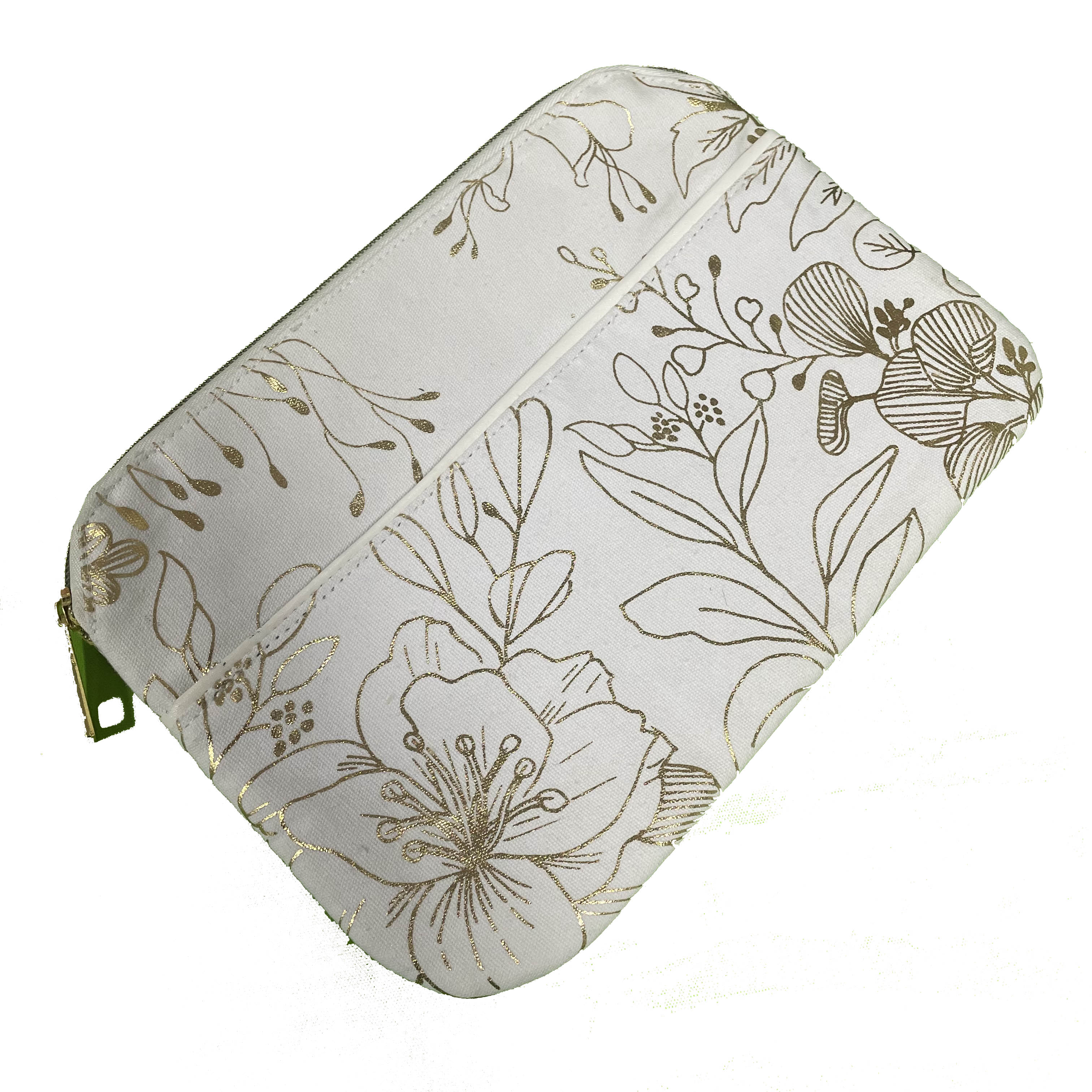
A sample that is only looked at proves nothing. Put it through these ten checks, ideally on a video call so there is no dispute about what you did:
| Test | Procedure & pass criteria |
|---|---|
| 1. Fill test | 200 ml of water, closed, inverted 30 minutes; check for wicking at seams. |
| 2. Solvent wipe | 20 passes with a remover pad, inside and over the print. |
| 3. Zip cycle | 200 full cycles; note tooth skipping, slider wobble, tape fraying. |
| 4. Fold test | 50 folds on the same line; look for white creasing and print cracks. |
| 5. Scratch test | A fingernail across the coating — scuffing to a lighter shade marks a low-grade finish. |
| 6. Load test | 1.5 kg inside, lifted by the handle ten times. |
| 7. Odour check | Sealed in a polybag for 24 hours, then smelled. |
| 8. Dimension check | Length, height, gusset and zip opening against the spec sheet. |
| 9. Lining retention | Pull the lining at the base; it should be fixed, not sliding. |
| 10. Hardware finish | Rub the plated pull with a dry cloth and check for plating transfer. |
One condition matters more: the sample must use bulk materials, not whatever was on the sample-room shelf. A prototype proves the design can exist; a pre-production sample proves it is reproducible. Approve only the second, signed and dated. Our quality control process shows where that sealed sample sits in the workflow.
Check 7: What Actually Protects Your Deposit?
The deposit is where your leverage is highest and your information lowest — use it to buy documentation, not promises. AQL 2.5 major, 4.0 minor, zero critical is a common structure for sewn promotional goods; the numbers matter less than the definitions, because “major” means nothing until you say what it looks like on a pouch.
| Defect class | Cosmetic pouch example | Typical AQL |
|---|---|---|
| Critical | Broken zip, sharp hardware edge, suspected hazardous coating | 0 |
| Major | Peeling lining, print misaligned over 3 mm, wrong zip, seam failure | 2.5 |
| Minor | Loose thread, faint surface mark, slight stitch wander | 4.0 |
Red flags that should end the conversation
| Red flag | What it means |
|---|---|
| Refuses a sealed pre-production sample | Bulk may differ from sample-room stock |
| No written ΔE or Pantone standard | Colour drift is guaranteed on reorders |
| No third-party inspection allowed | No independent check |
| 100% prepayment before production | No leverage on defects |
| Cannot name lining GSM or backing | Generic quote; substitution risk |
Confirm these in writing:
- Deposit and balance split: balance due on documents or on a passed inspection — and whether the sample fee is credited against bulk.
- Tooling ownership: screens, dies, emboss plates, print files — not reusable for another buyer.
- Third-party inspection right: balance released only on a passed report. Inspectors such as SGS work against your AQL and your sealed sample.
- Change control: any material, zip or print change needs written approval; verbally agreed “small improvements” are how specs drift.
- Packaging spec: polybag (with or without suffocation warning), hangtag, insert card, inner box and export carton. For gift-with-purchase programmes this is part of the product, not logistics.
- Artwork ownership, confidentiality, delay and force majeure: with the remedy stated rather than implied.
Two behaviours should stop the conversation: wanting 100% payment before production, and refusing third-party inspection. If you have CSR obligations, ask for the social audit report and check the factory name and address match the entity you pay — amfori BSCI and Sedex are audit programmes, not certificates, which is why the report itself has to be read.
What a Well-Run Pouch Programme Looks Like
Spec lock on lining, zip and print, with test results attached. Lab dip approved before bulk fabric is ordered, ΔE on paper, swatch held by both sides. A sealed sample in bulk materials, in-process checks at cutting, sewing and packing, and a reorder against that sample. This is where a first order at the MOQ floor earns its keep: a supplier who issues a sealed sample and cutting report for 1,000 pieces can usually reproduce them a year later.
Our notes on MOQ negotiation explain why some minimums are structural, and the pricing breakdown shows which line items move when you upgrade a lining or a zip. To see how these details map onto finished goods, browse the custom pencil cases and tote and shopping bags we produce under the same controls.
Run the seven checks on us
We would rather be checked than trusted. Ask for the lining spec, the lab dip procedure, a sealed zip sample and a tested pouch in your target material — then run the ten tests above before any deposit is discussed. If a construction will not survive them, we would prefer to say so at sampling stage.
Send your artwork, quantity, lining preference and delivery window, and we will reply with a specification and a quotation stating exactly what is included.
Email: info@bincai-intl.com
WhatsApp: +86 158 5793 5670
Inquiry form: bincai-intl.com/contact
Frequently Asked Questions
What MOQ should I expect for custom cosmetic bags?
Our standard is 1,000 pieces per style and colourway. Below that, the constraint is almost always the fabric dye lot and the print set-up rather than the sewing line — so ask which part of your specification is setting the floor, and you will usually find it is the material.
Is the sample fee refundable?
Ask whether the fee is credited against bulk, at what quantity, and how many revision rounds are included — unlimited “free” revisions usually mean nobody tracks the cost. Get the credit terms in writing before you approve the artwork.
How do I stop colour shifting between the first order and the reorder?
A signed swatch or Pantone reference held by both sides, a numeric ΔE tolerance in the PO, single-lot production. On reorders, send the original swatch with the PO and require a lab dip against it before production, not after.
Is third-party inspection worth it on a small first order?
For a first order with a new supplier, yes. The value is not only the defect count; it is the signal that someone independent will look, which changes how the line runs in the final week. If the order is too small, require dated photos of the sealed sample, cutting report and packed cartons before releasing the balance.
Which certifications actually matter?
Separate three things: social compliance (amfori BSCI, Sedex), material safety (OEKO-TEX, plus REACH or CPSIA by market and age group), and recycled content (GRS, if you claim RPET). Each answers a different buyer question, and each needs a report whose factory name and address match your supplier.
Can I order fewer than 1,000 pieces?
Sometimes, when the fabric is already in stock and the print is a single colour. It is a material question rather than a sewing question, so ask specifically whether the fabric can be bought in a smaller lot — that answer decides it, not the labour.
How long does a custom cosmetic pouch order take?
It depends on the production queue, fabric availability and whether a new screen or emboss die is needed, so a responsible factory confirms the schedule against your delivery window per order rather than publishing one number. Get the date in writing on the PO, and add your own buffer for freight.
Related reading: choosing bag fabric · first-order checkpoints · our factory